Fixed-budget accounting
On the reported 250-prompt pool, the ThinkPrior versus online-NP result reallocates a fixed 3,840-rollout budget; it is not a net generation saving.
Before rollout history exists
ThinkPrior uses an external-anchor zero-rollout difficulty prior for cold-start prompt selection, reducing silent groups before RLVR history is available.
Research question
Use a small external anchor to estimate pool difficulty once, before training. Convert its verifier-scored pass rate into a finite Beta initialization, rank prompts by expected learnability, then let target-policy outcomes update the posterior online.
An all-correct or all-wrong rollout group whose group-relative advantages are identically zero. Under the studied KL-free objective, it contributes no reward-advantage gradient.
The method
ThinkPrior changes prompt selection and posterior updates. It does not change the training loss or optimizer.
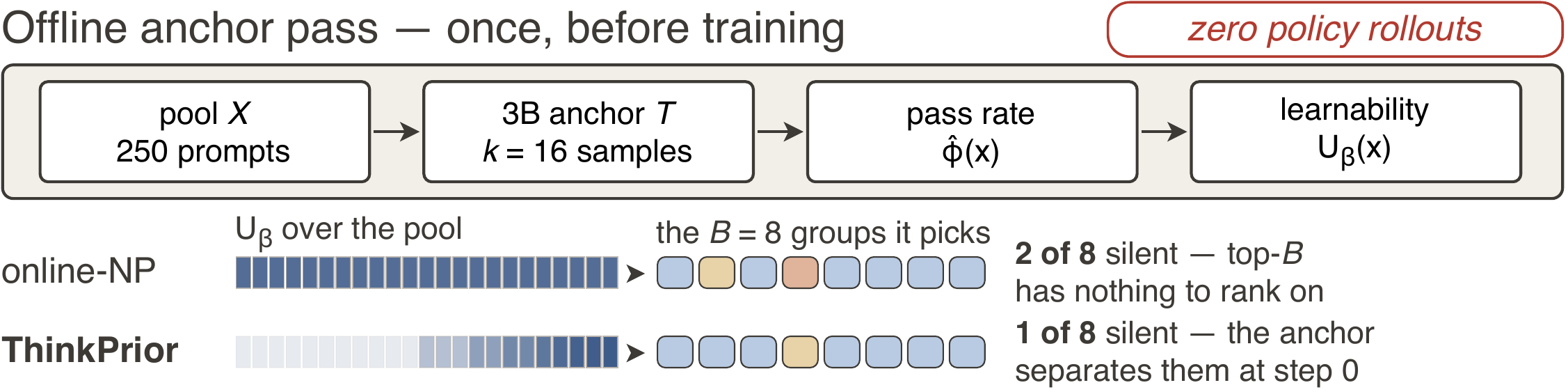
For every prompt x, sample the external anchor k = 16 times and use the verifier-scored pass rate φ̂(x) as a step-zero difficulty estimate.
Encode φ̂(x) as finite Beta pseudo-counts with κ = 4. The prior biases the cold start without pinning the later trajectory.
Rank candidates by posterior expected learnability. After selection, target-policy outcomes update the same posterior online.
Supported findings
Qwen2.5-Math-7B, GRPO with LoRA, a 250-prompt MATH pool, and 16 seeds per arm for the prior-isolating ThinkPrior versus online-NP comparison.
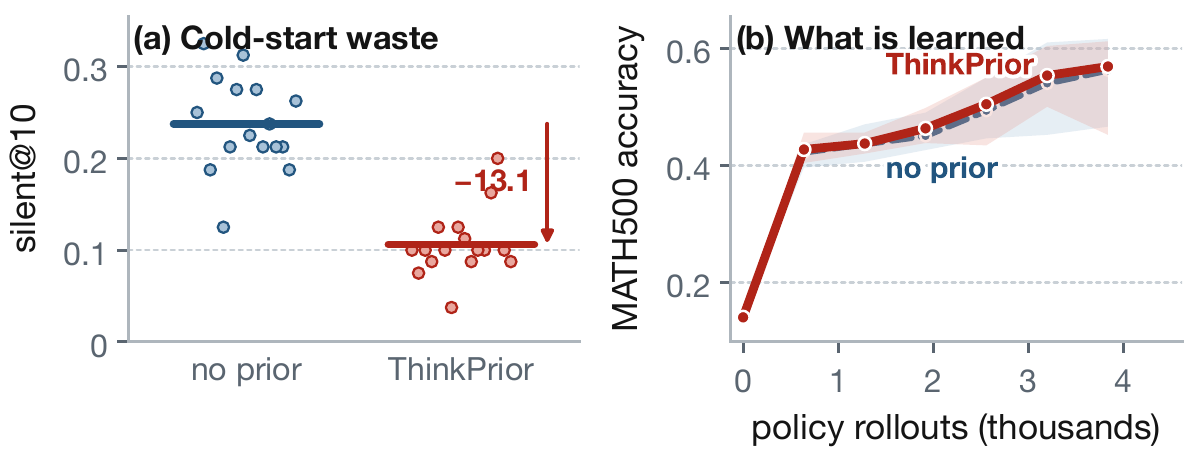
The evidence supports a cold-start benefit from the prior. It does not establish a final-accuracy advantage.
| Measure | ThinkPrior | Online-NP | Observed difference | Interpretation boundary |
|---|---|---|---|---|
| silent@10 | 10.6% ± 3.6 | 23.8% ± 5.1 | −13.1 points; −55% relative | 80 candidate groups per seed in steps 1–10; 95% CI [−16.4, −9.9] points. |
| waste@30 | 266 ± 30 | 329 ± 77 | −63 rollouts; −19% | Rollouts in silent candidate groups through step 30; 95% CI [−106, −20]. |
| Final MATH500 | 56.9% ± 3.7 | 56.2% ± 4.2 | +0.68 points | 95% CI [−2.2, 3.5] points; we detect no difference in final accuracy. |
Measured composition
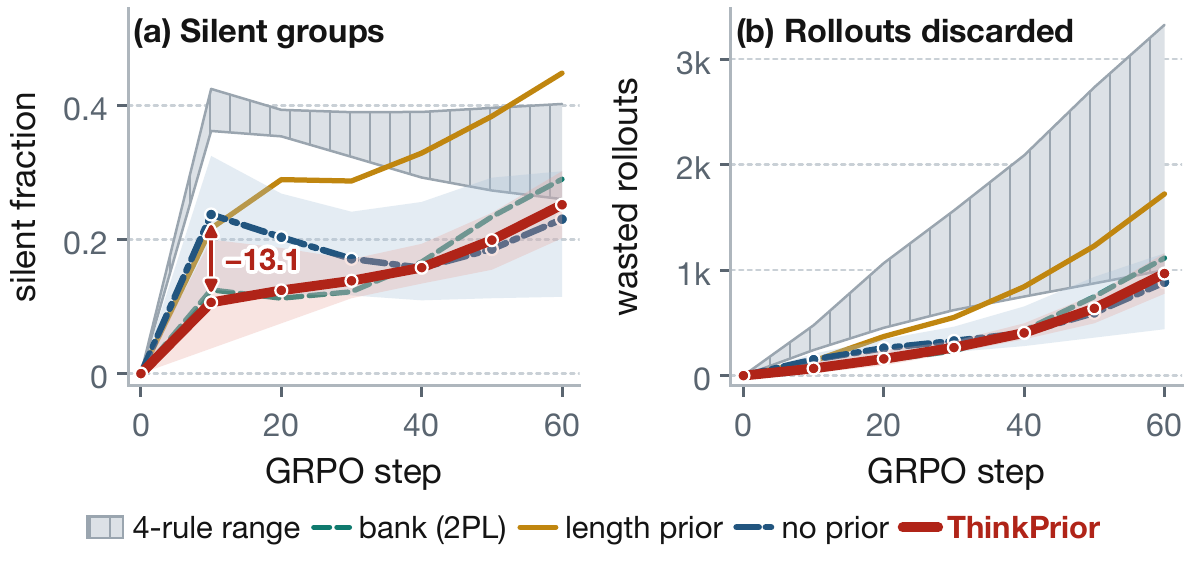
Over 60 steps and three seeds per arm, ranking DAPO candidates with ThinkPrior reduces generated rollouts from 8,256 to 7,381 (−10.6%). Both arms retain the same 3,840-rollout update budget and the same observed mean MATH500 accuracy of 60.5%.
The composition changes the candidate pool. This supports compatibility, not isolation of the initialization as the sole cause.
Limits & availability
ThinkPrior is presented as a cold-start selection prior—not a universal RLVR solution, a guaranteed accuracy improvement, or a fully off-policy selector.
On the reported 250-prompt pool, the ThinkPrior versus online-NP result reallocates a fixed 3,840-rollout budget; it is not a net generation saving.
The one-time probe uses 4,000 small-model generations. The paper does not claim a measured full-cost break-even point.
No target-policy rollout is needed before the first selection. Thereafter, the posterior uses target-policy outcomes.
Code, complete data, and training trajectories are not currently public. This repository publishes the preprint, selected explanatory figures, and citation surfaces only.
Citation
No DOI or arXiv identifier has been assigned on this public surface. Use the canonical project URL and update the record after a scholarly identifier exists.
@misc{sha2026thinkprior,
  title  = {ThinkPrior: Zero-Rollout Difficulty Priors for Cold-Start Prompt Selection in RLVR},
  author = {Sha, Tommy and Zhai, Skylar and Zhao, Siqi},
  year   = {2026},
  note   = {Preprint},
  url    = {https://shatianming5.github.io/thinkprior/}
}